
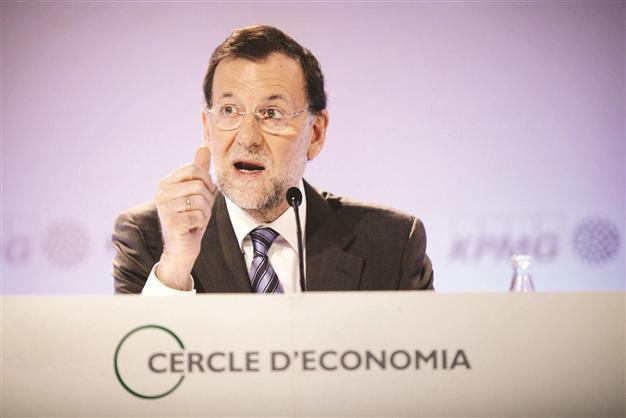
Spanish Prime Minister Mariano Rajoy, speaking at an economic forum over the weekend, tries to reassure the Spanish public that Spain will eventually exit the financial crisis.
Prime Minister Mariano Rajoy sought to reassure Spain on June 2 that the country would eventually exit the financial crisis, after a dismal week that saw its borrowing costs soar.MADRID - Agence France-Presse
Plummeting sales and rising taxes have sent tens of thousands of shops over the brink since Spain’s economic crisis erupted.
Cesar Calle’s general store, “Lemon Tea”, which opened 15 years ago in a working class district of Madrid, is no exception.
“Total clearance sale in desperation” says a sign posted up in the shop. The same words are emblazoned on the staff’s tee-shirts.
The shop once drew 1,000 customers a day but sales have plunged 30 percent since the crisis struck in 2008.
Calle, 53, has given up trying to save his business. “This severe crisis has been going on for three years and we can’t go on any more,” he said. “Customer numbers are down. Spending power is too. And taxes have more than doubled. We can’t take it.” In the aisles, a few bargain hunters inspect shelves of multicolored flower pots, glassware, furniture, and decorations, all being liquidated.
“Right now in Spain, any business that tries to follow the rules and do things properly, as we should, will have nothing but losses,” Calle said.
Since the start of the crisis tens of thousands of businesses have closed. According to the Spanish confederation of commerce, another 75,000 shops could pull down their shutters by the end of this year.
Shopkeepers now fear a rise in VAT, which the European Commission may demand in return for allowing Spain an extra year until 2014 to cut its public deficit to 3.0 percent of economic output, from 8.9 percent last year.


