Turkish president cuts Africa trip to attend Saudi King Abdullah’s funeral
RIYADH

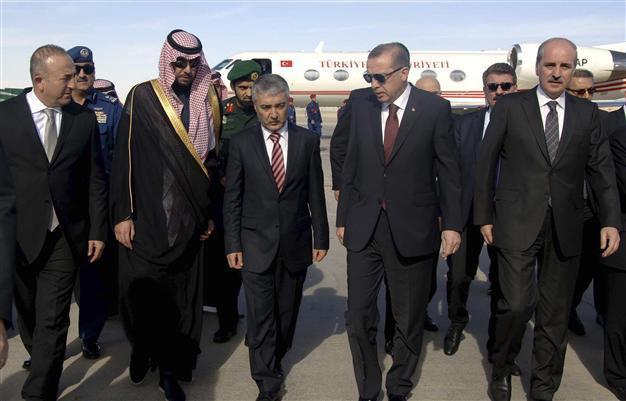
Turkey's President Tayyip Erdoğan (front 2nd R) arrives to take part in the funeral of Saudi King Abdullah bin Abdulaziz in Riyadh January 23, 2015. REUTERS Photo
Foreign leaders gathered in a cavernous mosque in the Saudi Arabian capital on Jan. 23 for the funeral of King Abdullah.
Turkish
President Recep Tayyip Erdoğan, Pakistani Prime Minister Nawaz Sharif
and the leaders of Sudan and Ethiopia joined Gulf rulers for the funeral
prayer at Riyadh's Imam Turki bin Abdullah mosque.
Erdoğan said he has postponed his planned trip
to Somalia to attend the funeral of Saudi Arabia's King Abdullah, a day
after a bomb targeted a Turkish delegation in the capital Mogadishu.
"We've
decided to go [to Riyadh] and are heading there now. But we are also
going to continue our programme and go to Djibouti and Somalia," Erdoğan
told reporters in comments broadcast live by state television TRT.
Erdoğan
said he will travel to Djibouti after the funeral, and sources in his
office said the Turkish leader is expected to go to Somalia on Jan. 25.
"It's
just a postponement. He will be coming to Somalia after the funeral but
we don't know the exact date or the time," Daud Aweis, spokesman for
the Somali presidency, told Reuters.
A suicide bomber on
Thursday rammed a car laden with explosives into the gate of a Mogadishu
hotel where Turkish and Somali delegates were meeting, killing two
security guards.
The foreign leaders prayed alongside Abdullah's successor and half-brother, King Salman.
Television
pictures showed Abdullah's covered body borne on a simple litter
carried by members of the royal family wearing traditional red-and-white
checked shemagh headgear, following prayers.
Prince Miteb bin Abdullah, the National Guard minister and a son of the late king, was among the litter-bearers.
The body was quickly moved to nearby El-Ud public cemetery.
In
keeping with the kingdom's strict Muslim traditions, he was to be
buried in an unmarked grave as was his predecessor King Fahd, who died
in 2005.
Bahrain's King Hamad, Qatari Emir Sheikh Tamim
Bin Hamad al-Thani, a high-level delegation from the United Arab
Emirates, and Kuwait's Emir Sheikh Sabah al-Ahmad al-Sabah were among
other leaders at the funeral which followed the ailing Abdullah's death,
at the age of about 90, early Friday.
US President Barack Obama was quick to pay tribute to Abdullah as a valued ally.
"As
our countries worked together to confront many challenges, I always
valued King Abdullah's perspective and appreciated our genuine and warm
friendship," Obama said in a written statement shortly after the
monarch's death.
"The closeness and strength of the partnership between our two countries is part of King Abdullah's legacy."
Other tributes came in from Japan,
India and France, whose President
Francois Hollande hailed Abdullah as "a statesman whose work profoundly marked the history of his country."
Hollande
will travel to Saudi Arabia to "offer
his condolences" over King Abdullah's death, the presidency said Friday.
The Elysee palace added that the exact timing of the trip had yet to be
decided.
Israel's former president Shimon Peres said the death of King Abdullah was "a real loss for the peace of the Middle East".
"He
was an experienced leader and a wise king. He had the courage ... to
stand up and introduce a peace programme for the Middle East," said
Peres, referring to the 2002 Arab Peace Initiative.
Iran offered
condolences Friday to the people and government of Saudi Arabia upon the
death of King Abdullah and said Foreign Minister Mohammad Javad Zarif
would travel to Riyadh.
In a statement on its foreign ministry website,
Iran said Zarif "will take part in an official ceremony" in the Saudi capital on Saturday, without giving further details.
Islamic militants celebrate Saudi king's death online
BEIRUT - Associated Press
Islamic militants and their supporters celebrated the death of Saudi
King Abdullah on social media Friday, many of them describing him as a
"servant" of the Americans who conspired with the West to kill Muslims.
Abdullah,
who died at the age of 90, began battling al-Qaida militants around a
decade ago when extremists launched a string of attacks in the kingdom
aimed at toppling the monarchy. Backed by the kingdom's top ally, the
United States, Saudi officials responded with a massive crackdown and
has imprisoned suspected militants and sentenced others to death.
Many
Islamic extremists consider the Saudi royal family to be corrupt. The
Islamic State of Iraq and the Levant (ISIL), an al-Qaida breakaway group
that currently holds a third of Iraq and Syria, often cites Islam's
holiest city of Mecca in Saudi Arabia, as one of its targets. Saudi
Arabia is also part of a U.S.-led coalition targeting the ISIL in
airstrikes.
A man who identifies himself as an ISIL
supporter who uses the name Abu Azzam al-Najdi criticized the late king
on Twitter, saying: "He sent his warplanes to kill Muslims in (Syria).
He imprisoned Muslim men and women and wherever there was a war against
jihadis, he was the first."
Some loyalists of al-Qaida and the ISIL also used a hashtag that translate from Arabic into "Death of a Tyrant."
Social
media provides a forum for militants and their supporters to air their
statements and propaganda videos. Such users typically do not give their
full names, if at all, using instead nicknames and pseudonyms.
A
jihadi supporter who identifies himself by the name of Omar wrote in
English: "The dog that was occupying (the land of the two holy shrines)
has finally kicked the bucket, no Bush or Obama to save you from Allah."
One
user posted a photo illustration of King Abdullah wearing an orange
uniform as a masked man stood behind him carrying a knife to behead him.
"We
don't want him to die. We want to slaughter him this way," the post
said, referring to Saudi Arabia's tradition of beheading criminals.