EU urges opening key chapters with Turkey, despite lingering worries: Draft resolution
Güven Özalp BRUSSELS

The European Union is planning to express support for opening three
chapters concerning judiciary, freedom and economy with Turkey, despite
highlighting concerns over Ankara’s handling of the aftermath of a graft
crisis, according to a draft final resolution to be discussed during an
upcoming EU leaders' meeting.
“The Council looks forward in due
course to the definition of the opening benchmarks for the key Chapters
23 and 24 and their possible future opening,” reads the draft seen by
daily Hürriyet.
The leaders of the 28 EU member countries are
expected to gather for a summit in Brussels on Dec. 18 and 19 to discuss
a number of issues.
Opening benchmarks for Chapter 23, on the
judiciary and fundamental rights, and Chapter 24, on justice, freedom
and security, have been on the EU’s agenda as part of Turkey’s
membership bid, but the Greek Cypriot government's veto has been
impeding the process.
Encouraging Turkey “to work on reforms that
should provide for adequate checks and balances fully guaranteeing
freedom,” the draft also keeps an account of the EU’s concerns over
political interference in the judiciary in Turkey.
“The Council
remains concerned at the undue interference by the executive in the
judiciary, frequent changes to key legislation without due consultation
of stakeholders and restrictions on access to information,” the draft
says.
Within this respect, the statement also emphasizes the
28-nation bloc’s worries over the Justice and Development Party (AKP)
government’s way of dealing the corruption allegations.
“The
Council regrets that the response by the government to the alleged cases
of corruption in December 2013 cast serious doubts over the
independence and impartiality of the judiciary, and demonstrated an
increasing intolerance of political opposition, public protest and
critical media,” it states.
“In this regard, the Council
emphasizes the important role of the Constitutional Court and takes
positive note of the growing and active civil society in Turkey, which
should be further supported and encouraged as a legitimate stakeholder,”
the statement added.
Emphasis on economic cooperationMeanwhile,
the draft also indicates the bloc’s will for progress in economic
cooperation by issuing a call for opening Chapter 17 that concerns
economy and monetary policies.
“Given the strong economic links
between Turkey and the EU, the Council calls for the development of a
high-level economic dialogue. Progress under Chapter 17 [economic and
monetary policy] would in due course further support such dialogue and
encourage alignment with the acquis,” the draft reads.
The shift
in the EU’s stance regarding the discussion of economic integration came
after France signaled it will ease its block on opening the chapter in
Turkey’s EU accession negotiations.
The draft also marks one of
the most tangible remarks from the EU side regarding Turkey’s insistence
on updating the Customs Union between Turkey and the EU to reflect
Ankara’s concerns about the EU’s free trade agreements with third
parties.
The draft says the council “looks forward to discussions
with the Commission on the Customs Union,” asserting solutions will be
sought “also in light of the publication of the World Bank study
completed in 2014.”
Turkey has been voicing its concern over a
number of FTAs signed by the EU, especially the Transatlantic Trade and
Investment Partnership (TTIP) between the EU and the U.S. But the EU was
reluctant to address the problem directly, insisting the issue should
be settled through a separate Turkish-U.S. deal.
The World Bank
report referred to in the draft says the Customs Union is beneficial to
both Turkey and the EU, yet the smooth implementation of the scheme is at risk if the problems that have risen due to economic changes are
not tackled.

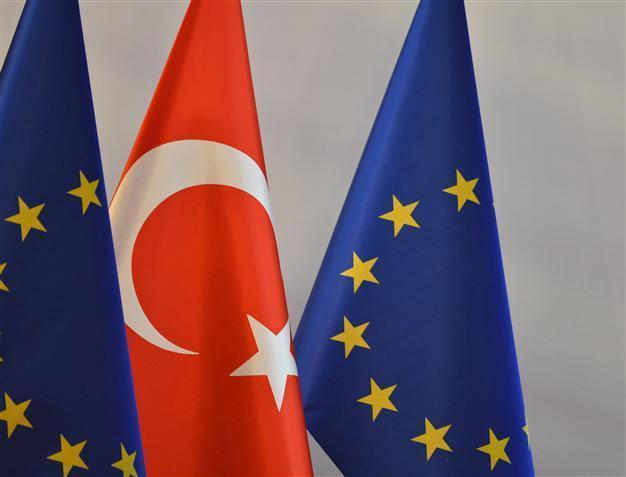 The European Union is planning to express support for opening three
chapters concerning judiciary, freedom and economy with Turkey, despite
highlighting concerns over Ankara’s handling of the aftermath of a graft
crisis, according to a draft final resolution to be discussed during an
upcoming EU leaders' meeting.
The European Union is planning to express support for opening three
chapters concerning judiciary, freedom and economy with Turkey, despite
highlighting concerns over Ankara’s handling of the aftermath of a graft
crisis, according to a draft final resolution to be discussed during an
upcoming EU leaders' meeting.


