Austerity blame-game dominates EU debate
BRUSSELS

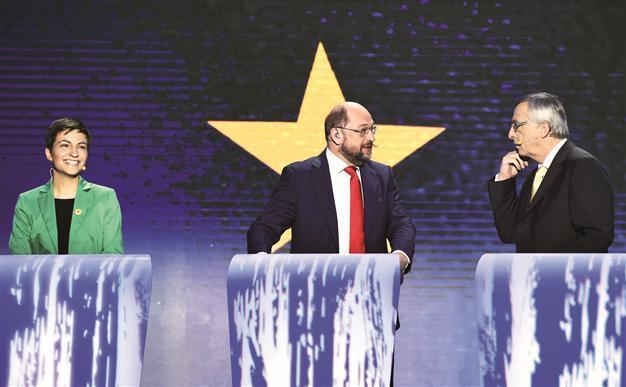
The top candidate for the German Social Democratic Party (SPD) for the 2014 European elections, Martin Schulz (L), and the candidate
for the center-right European People’s Party (EPP),
Jean-Claude Juncker, are pictured before a
debate in Brussels. AFP photo
he five top candidates to head the European Commission swapped
accusations on May 15 over the impact of Europe’s austerity measures and
the role played by banks in sparking the economic and financial crisis.
The elections will take place between May 22-25.
In an often heated
debate in Brussels, several candidates were forced onto the back-foot by
Greek radical-left leader Alex Tsipras, who wasted no time in
denouncing “catastrophic austerity policies” and demanding an exit from
“debt paranoia.”
Conservative leader Jean-Claude Juncker, the former
prime minister of Luxembourg who headed the single-currency Eurogroup
for eight years, pounced on Tsipras’s remarks, rejecting the suggestion
he had not acted in the best interests of Greece.
“I worked for
years, day and night, to prevent Greece leaving the eurozone,” Juncker
said, adding that he had done everything in his power to help the ailing
country while endeavouring to get its public finances in order.
Guy
Verhofstadt, the candidate from the center-right liberal grouping ALDE,
mocked Tsipras’s suggestion that banks and EU banking policies were to
blame for southern Europe’s economic woes.
‘Not a matter of banking’“In
Greece, in Italy, it wasn’t a matter of banking, but bad policies on
the part of your political parties,” Verhofstadt told Tsipras, defending
the need for fiscal discipline in the EU as it struggles to move out of
recession.
“You need fiscal discipline, otherwise you cannot have
growth... and that means making no new debt,” Verhofstadt said, adding
that the best way forward was to make the most of the EU’s common market
by removing economic barriers within the 28-member bloc.
Greens
leader Ska Keller, the only woman in the race to become the next
president of the European Commission, said that more austerity in the EU
would “worsen the situation,” but called on member states to do more to
invest in “sustainable jobs” in renewable energy.
Socialist leader
Martin Schulz, the outgoing president of the European Parliament, agreed
the EU had made a mistake in “unilaterally cutting” spending, but
pointed to the fight against tax fraud and tax evasion as the best way
of providing relief to state coffers.
The debate was the first of its
kind to include all five parties in the running for the Commission
presidency, which is the highest executive position in the EU. In a
break from earlier formats, three of the candidates spoke English, while
Juncker chose French and Tsipras used Greek.
The event, broadcast
from the European Parliament building in Brussels by 50 TV stations and a
variety of radio stations and websites across Europe, was moderated in
English by an Italian journalist.
One of the only two moments of
policy agreement in the debate came when discussing the EU’s policy
setting on asylum-seekers, following another shipwreck off the coasts of
Italy this week which claimed 17 lives.