Turkish daily Taraf's reporter faces spying probe for leak story
ISTANBUL

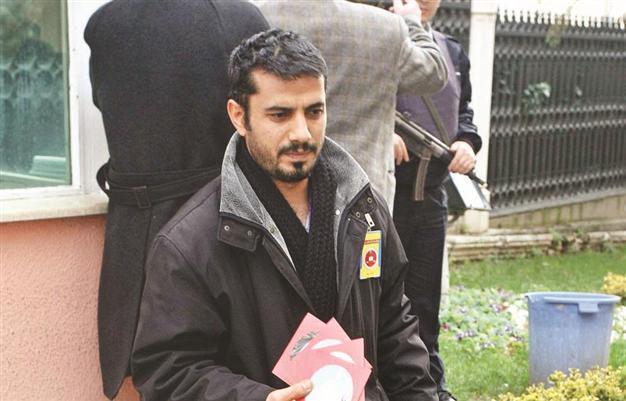
Baransu has had his name under many ‘leak reports’ that set Turkey’s agenda throughout the AKP’s time in government. DHA photo
Prosecutors have launched an investigation into daily Taraf reporter and
columnist Mehmet Baransu, after he controversially revealed a document
from a 2004 National Security Council (MGK) meeting.
The probe is
investigating charges of “obtaining documents regarding state
security,” “political or military spying,” “exposing documents regarding
the state’s security or political good,” and “revealing forbidden
information,” over Baransu’s publication of a state action plan against
the activities of Islamic scholar Fethullah Gülen’s movement.
The document, published by the newspaper on Nov. 28, had heated up the row between the government and the Gülen movement.
Deputy
Prime Minister Bülent Arınç subsequently confirmed the document’s
existence, but denied that any action had been taken after its signing.
The document was signed by, among others, Prime Minister Recep Tayyip
Erdoğan and other Cabinet members.
Arınç said the government
definitely did not follow through with the recommendations, and also
added that revealing secret documents was a crime and prosecutors should
deal with it accordingly.
The Anatolia Public Prosecutor Press
Crimes Bureau launched an initial investigation into Taraf’s report but,
following a ruling of lack of jurisdiction, the file was sent today to
the Istanbul Public Prosecutor, which is in charge of terror crimes.
The
Prime Ministry, the National Intelligence Organization (MİT) and the
National Security Council (MGK) on Dec. 4 filed criminal complaints
against Taraf and its reporter Baransu over the revelation of the 2004
MGK decisions.
Main opposition: Cases against daily a blackoutMain opposition Republican People’s Party (CHP)
leader Kemal Kılıçdaroğlu said criminal complaints filed by the Prime
Ministry, the MİT and the MGK against a journalist from Taraf aimed to
“hide the truth from people.”
“If you limit freedom of newspapers
and journalists, then you limit people’s right to be informed,”
Kılıçdaroğlu said in response to questions on Dec. 6.
“Taraf is
an important newspaper, it is reporting whether you like it or not. But
free reporting of journalists is one of the fundamental conditions of
democracy. Everybody should be careful about this.
The filing of
criminal complaints is aimed at preventing people from learning certain
truths that are being hidden by the government from the people. In that
regard, I don’t think it is right,” he said.
The Dec. 6 edition
of Taraf featured an editorial on its front page penned by its
editor-in-chief, Neşe Düzel, stating “You cannot silence us.”
The
reporter under investigation, Baransu, has had his name under many
“leak reports” that set Turkey’s agenda throughout the AKP’s time in
government. He had previously exposed documents related to Balyoz, a
military coup plot against the ruling AKP said to have been planned in
2003.
Baransu also reported in June that Turkey’s intelligence
agency MİT and various other organizations had signed protocols to
collect detailed information about every individual in Turkey.
He
was acquitted on charges of making “confidential and prohibited
documents” public in 2010, after a lawsuit was filed against him over
his report on military intelligence about an attack at Turkey’s Aktütün
outpost in the southeastern province of Hakkari in October 2009.
The
Turkish Air Forces Command had also filed a complaint against Baransu
and Taraf’s managing editor for slandering the Turkish Armed Forces
(TSK) and its personnel through their reports of fraud inside the army.