Turkey-US train-equip program for Syrian opposition to kick off March 1
Sevil Erkuş ANKARA

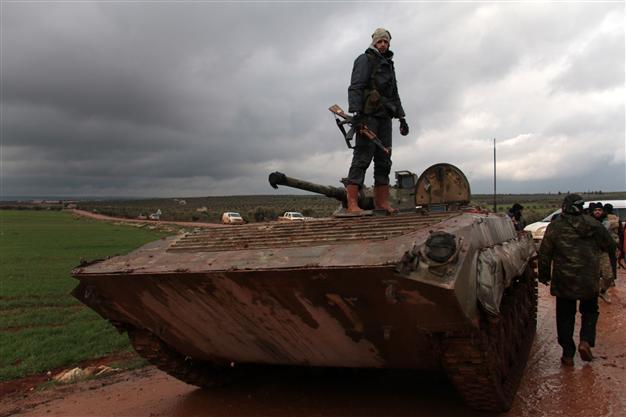
A rebel fighter stands on a tank near the frontline in the village of Ratyan in the countryside north of the Syrian city of Aleppo on Feb. 19, 2015. AFP Photo
Turkey and the United States will begin training and equipping moderate Syrian opposition fighters on March 1 within the framework of a Feb. 19 agreement signed by the two countries, Ankara has announced.
“I can say that it will begin as of March 1,” Turkish Foreign Ministry spokesperson Tanju Bilgiç briefly told reporters at a press conference on Feb. 27.
According to the memorandum of understanding (MoU) sealed by U.S. Ambassador to Ankara John Bass and Foreign Ministry Undersecretary Feridun Sinirlioğlu, Ankara will provide an equal number of trainers to work alongside their American military counterparts.
Hours before the signing of the MoU, Turkey’s Foreign Minister Mevlüt Çavuşoğlu suggested Syrian opposition groups to be trained and equipped by the joint U.S.-Turkey program will also fight against the Syrian regime.
The trained Syrian opposition members are “expected to fight against the Islamic State of Iraq and the Levant [ISIL] and elements of the [Syrian] regime,” Çavuşoğlu said Feb. 19 to answer whether the program also aims to struggle against Syrian regime forces. Turkey and the U.S. were on the same page on this issue, Çavuşoğlu said.
More recently, as of Feb. 25, EU Minister Volkan Bozkır stated that the use of regionally strategic İncirlik Air Base as part of the international campaign against the extremist jihadists in Syria depends on the results yielded by the train-and-equip program.
Bozkır reiterated Turkey’s demand to establish a secure zone for Syrian immigrants, as well as the moderate troops who undertake the train and equip program, and recalled the formation of a no-fly zone for the protection of that particular area inside Syria. “The use of İncirlik alone or as part of the international campaign depends on obtaining these results,” he said.
US spymaster ‘unfair’ in his criticism against Turkey Turkey’s political will against ISIL, is clear, as is its policy of defining the jihadist group as terrorists, Bilgiç said.
“Saying
that Turkey has been slow in fighting against terror or has acted
negligent is not fair,” Bilgiç said in response to a question on Feb. 26
remarks by U.S. Director of National Intelligence James Clapper, who
said Turkey does not place a high priority on fighting ISIL and foreign
fighters are able to travel through the country into Syria as a result.
“Our
policy regarding DAESH [ISIL] is extremely loud and clear: We recognize
it as a terrorist organization. It is no different than any other
terrorist organization,” Bilgiç said, as he cited the Mosul incident,
during which ISIL kept 49 members of the Turkish Consulate in Mosul
hostage for nearly three months, as an example of a “terrorist” action.
“Our
political will on this issue is clear,” he said. “Turkey is a partner
of the international coalition in the fight against DAESH. It has
displayed its will by participating in all meetings held within the
content of the fight against DAESH,” he said.
“We have stated the
fight against DAESH could not be fairly conducted. We have stated the
main reasons which led to terror needed to be dried out and the fight
needed to be conducted within this framework,” he added.
“Nobody
should have doubts about Turkey’s determination,” Bilgiç said, while
delivering a call for Turkey’s foresight, particularly in fight against
terrorism, to be heeded. Addressees of his call were apparently Turkey’s
partners in the international coalition against ISIL.