Turkey, Russia work on new plan for Syria
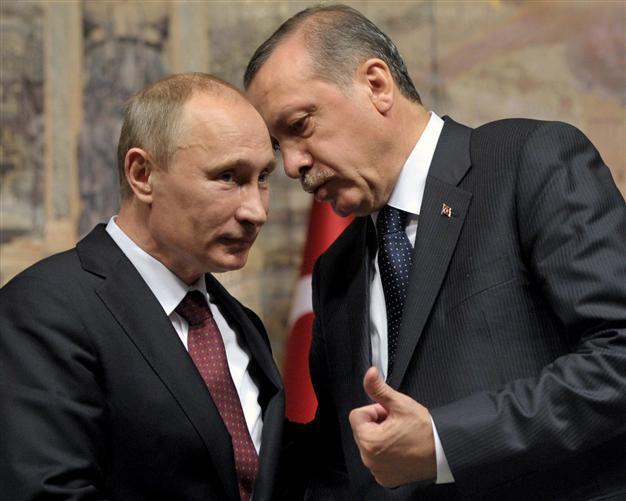
Turkish Prime Minister Recep Tayyip Erdogan, right, and Russian President Vladimir Putin speak to each other at a news conference in Istanbul, Turkey, Monday, Dec. 3, 2012. The leaders of Russia and Turkey on Monday downplayed differences over the Syrian civil war, saying they shared the common goal of trying to end the humanitarian crisis there and hailing their countries' booming trade ties. (AP Photo/RIA-Novosti, Alexei Nikolsky, Presidential Press Service)
Turkish government sources confirmed that Turkey and Russia have agreed to work on a plan for “political change” in Syria, following the Kremlin’s announcement that diplomats of both countries would “soon start working on new ideas” for ending the conflict in Syria. “Now we are doing our homework and Russia is doing theirs,” a high-ranking Turkish official, who asked not to be named, told the Hürriyet Daily News on Dec. 6; they could come to a stage of meeting on the issue “in weeks.”Both Turkish and Russian officials confirmed that an agreement to start joint work on Syria was decided on by Russian President Vladimir Putin and Turkish Prime Minister Tayyip Erdoğan during Putin’s visit to Istanbul on Dec. 3. According to Turkish sources, there was an agreement behind Putin’s remark that “We share the same views about what is going on in Syria” in the joint press conference with Erdoğan, which could be summarized in one sentence: Political change in Syria is necessary.
This expression is important to show the evolution of Russian policy regarding Syria, as a country which vetoed (together with China) the approval of any United Nations resolution on Syria. Putin had actually signaled a clarification in Istanbul on the state that his Syria policy reached by underlining that Russia “was not an advocate” of the Bashar Al-Assad regime in Syria; the highest-ranking move so far to distance Russia from the Baath regime in Damascus. Putin’s spokesman Dmitry Peskov moved this stance a step forward in a Dec. 5 statement in Ashgabat by saying that the “exit or the continuation of the Assad regime is absolutely not a must.” The statement could be read to mean that the continuation of the Assad regime as the only country in the Middle East and Mediterranean that provides a military base (in Tartus) for Russia is no longer that relevant.
According to Turkish sources, Russian and Turkish parties have also shared the view that the extension of the existing situation in Syria could mean more loss of life in the country and democracy would be the best regime for a “new Syria.”
Ankara and Moscow still do not fully agree on how to handle the political change in Syria. “Russia insists on a Syrian-owned process,” the ranking Turkish source told Daily News, “and we say that the Syrian opposition as it is now already consists of native elements.”
As both sides are doing their part to see whether a more result-oriented effort is possible (including rejected Russian proposals to Assad to secure a new life outside of Syria, in a Latin American country, for example), it appears that a conference next week might play a key role. That is the Friends of the Syrian People conference to be held on Dec. 12 in Rabat, Morocco, which the newly formed Syrian National Coalition is expected to attend for the first time. The Turkish side believes that depending on the structure and stance of the Syrian opposition in Morocco, there may be new steps from Russia that might speed up the process of political change in Syria.