1 Comment
PRINTER FRIENDLY
ECONOMIC REVIEW |
Tuesday, February 09 2010 02:07 GMT+2
Your time is
|
EU forecasts 5.8 pct contraction for Turkey
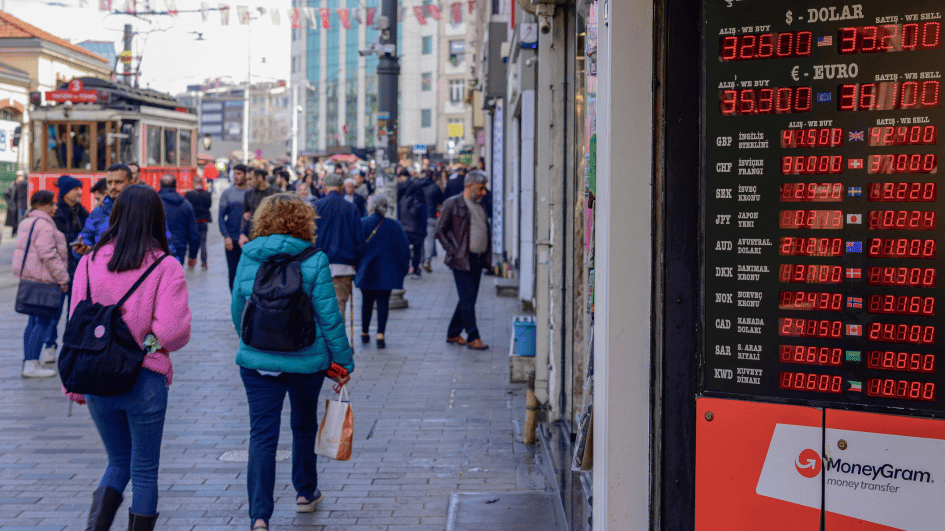
An employee at a currency exchange shop counts stacks of Turkish Liras in the Taksim area of Istanbul, Turkey, in this file photo. Bloomberg photo
|
The European Commission has forecasted a contraction of 5.8 percent in the gross domestic product for Turkey this year, in addition to estimates of 2.6 percent and 3.6 percent growth for 2010 and 2011 respectively.
In its “European Economic Forecast-Autumn 2009” report released on Tuesday, the commission noted the devastating effect of the global economic crisis on the Turkish economy last year. “After an outstanding growth performance during 2002-06, the Turkish economy started to decelerate already in 2007,” it noted. “Domestic factors, such as increased political uncertainty, a slowdown of reforms and tight monetary policy following the currency crisis in mid-2006 took a heavy toll on the growth dynamics.”
As the global crisis hit, Turkey was cornered mainly “via the trade and financial channels,” the report said. “In the last quarter of the year, real GDP contracted by 6.5 percent in annual terms as exports and investment declined by 8.5 percent and 17.6 percent respectively. Global demand shrank fast in sectors such as automotive and white goods.”
At the same time, “lower private external inflows and decelerating domestic credit” led to a 5.3 percent annual decline in private consumption, the commission said. “The combined trade and financial shock disrupted activity in the manufacturing sector, causing a 12.6 percent decline in industrial output in the last quarter of 2008. Overall, real GDP growth slowed to below 1 percent while investment growth had already turned negative by 5 percent in 2008.”
The financial sector owed its resilience in the face of the crisis to previous structural reforms, the report said. “The authorities could also afford to significantly loosen both the monetary and fiscal stance in response to the crisis,” the commission said in the report. “This helped cushion the downturn and, in particular, the decline in private consumption.”
Marginal improvement:
After the record 14.3 percent contraction in the first quarter of this year, seasonally adjusted real GDP increased by around 7 percent quarter-on-quarter in the second quarter, the report said. “But investments and exports improved only marginally compared to their disappointing performance in the first quarter, suggesting that the pace of the recovery would slow down once the effects of the fiscal stimulus fade away,” it said. “Overall, economic output is expected to decline by 5.8 percent in real terms in 2009.”
The commission said it also expected private consumption to drop by almost 5 percent even though this is cushioned by government fiscal incentives. “The decline in total domestic demand would be somewhat alleviated by the 3.2 percent growth in public consumption,” it said. “Among the domestic demand components, investment is forecast to experience the sharpest decline, in excess of 20 percent. A substantial de-stocking as companies try to adjust to lower sales is also expected to contribute negatively to growth.”
The decline in global demand may lead to a double-digit decline in exports, the report emphasized.
“The feedback loop from the underperforming real economy to the financial sector is likely to remain subdued given the still moderate increase in nonperforming loans,” the report said. “The banking sector is well capitalized and its exposure to currency and maturity mismatches remains limited. Nonetheless, loan growth has decelerated markedly in the crisis due to external financing constraints, lower economic activity and tightened lending standards.”
This factor is “likely to slow the recovery of private consumption and investment,” Tuesday’s report said. “Moreover, the notable increase in public sector borrowing requirements would further limit the availability of credit for the private sector. The recovery of investment in equipment is likely to be hampered by the low capacity utilization rate, which is still about 10 percentage points below the 2007 average.”
The commission forecast that the public debt-to-GDP ratio will rise to over 51 percent of the GDP in 2011.
READER COMMENTS
Guest - VINCENT MYERS (2009-11-04 17:19:00) :
- MOST POPULAR
- MOST COMMENTED
- Turkish man accused of burying daughter alive faces life
- US, Switzerland cool to Turkish quest for assurance on Armenia ties
- Cigarette consumption reduced in time for boycott day
- Marmaray workers put down tools in protest
- Fans fight rain in Istanbul to watch Saints' victory in NFL Super Bowl
- Gül says new charter is not possible
- Aggrieved families demand justice at Dink trial
- SunExpress to offer Aydın figs to passengers
- TURKISH PRESS SCAN FOR FEB. 8
- Storm hits western Anatolia
- Turkish man accused of burying daughter alive faces life
- US, Turkey discuss new action plan against PKK
- US lawmakers to debate resolution on Armenian
- Turkey criticizes US envoy’s comments on domestic politics
- The Diyanet and laïcité: new Turkish exports to Europe
- How to save Greece?
- US, Switzerland cool to Turkish quest for assurance on Armenia ties
- Cigarette consumption reduced in time for boycott day
- Prison sentences demanded for ‘murderer’ slogan
- Turkish ship runs aground in Adriatic Sea

WRITE A COMMENT