Merkel meets Putin in Kremlin for 'critical dialogue'
MOSCOW - Agence France-Presse
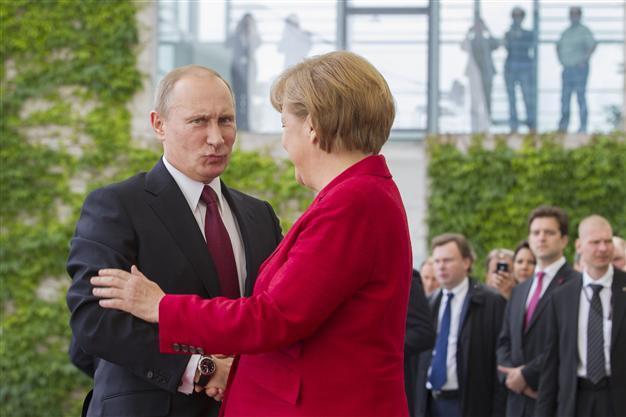
German Chancellor Angela Merkel (R) welcomes Russian President Vladimir Putin before talks at the Chancellery in Berlin, June 1, 2012. REUTERS photo
President Vladimir Putin on Friday hosts German Chancellor Angela Merkel for the first time in his third Kremlin term as Berlin adopts an increasingly critical stance over Russia's shady rights record.Merkel must tread a fine line between expressing rights concerns and the need to protect Berlin's economic interests as a top client of state gas giant Gazprom as well as a leading investor in an overhaul of Russian infrastructure.
Moscow has been particularly needled by the public comments of Andreas Schockenhoff, the German government's coordinator for German-Russian relations, who has shown no fear in taking issue with the Russian rights record.
"There is a dearth of warmth in relations between Putin and Merkel, now it will be altogether gone," Fyodor Lukyanov, editor of Russia in Global Affairs magazine, told AFP.
Germany and other EU states have expressed concern over a crackdown on civil society since Putin returned to the Kremlin in May which has seen activists arrested, the Pussy Riot rock band jailed and draconian new laws passed.
Foreign Minister Guido Westerwelle ahead of the visit stressed the need for a "critical dialogue" with Russia, warning that "partnership does not mean doing away with criticism." A week before the talks, German lawmakers passed a resolution co-authored by Schockenhoff urging the government to push for more democracy and warning of a "confrontational course towards government critics" in Russia.
Stefan Meister, a Russia expert at the German Council on Foreign Relations, said "disillusionment" had clouded Berlin's relationship with Russia since Putin's return and the end of his predecessor Dmitry Medvedev's stabs at reform.
"Germany is striving for more rule of law -- Russia's elite would like to prevent exactly that," he wrote in a recent commentary for German newspaper Die Zeit's online edition.
Schockenhoff, who criticised the Russia government for its stance on Syria and the handling of critics, has been accused by the Russian foreign ministry of lacking competence for his job.
'A unique opportunity'
Yet analysts also doubt Germany is prepared to risk its relationship with Russia despite the new tensions given the economic interests at stake.
"Merkel and Schockenhoff will make tough remarks -- and it will end at that," said Vladislav Belov, head of the Centre for German Studies at the Russian Academy of Sciences' Institute of Europe. "This will be her curtsey to German society and the European Union." Lukyanov added: "It's extremely important for German business to confirm its status as a priority economic partner." "Germans are our partners in machine-building, they expect to take part in privatisation and on the whole participate in Russia's technical overhaul." A fluent German speaker who spent five years as a KGB agent in Dresden, Putin has long prided himself on building a solid working relationship with Merkel, even though it has lacked the camaraderie he cultivated in his ties with her predecessor Gerhard Schroeder.
He conspicuously made Berlin his first European destination after his inauguration in May.
Putin's spokesman Dmitry Peskov told AFP energy and the euro zone crisis will be among top issues, noting that Russia holds a large chunk of its foreign reserves in euros.
The European Union's ongoing probe into Gazprom over concerns it was hindering competition in Europe is expected to be addressed, too.
Human Rights Watch has urged Merkel to tell Putin to end the crackdown on civil society, saying her visit was a "unique opportunity" to make it clear the EU's concerns to the Russian strongman.
Addressing the criticism of Kremlin's rights record, Peskov said: "Unfortunately some politicians are still in the captivity of stereotypes," and added that Moscow also had questions for Berlin over Germany's rights record.